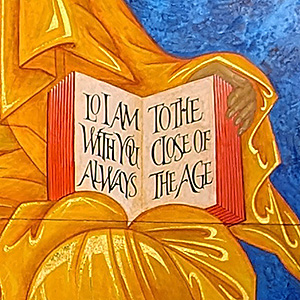
Christ the King Icon
The Christ the King Icon also known as "Christ Pantokrator", above the altar was painted by Sr. Petra Clare, especially for Our Lady's church. Here, Sr. Petra Clare explains the icon in her own words:

EXPLANATION AND INTERPRETATION OF THE ICON
The icon is a Christ Pantokrator (Ruler of All) and is the type you will find occupying the central dome of a Byzantine Church, and expressing the Majesty of Christ who has been with the Father from the beginning, and is the image of the invisible God, who was incarnate for our redemption and will come again to judge the quick and the dead. It refers to the eternal majesty of the Godhead.
The iconographic type of the Christ-Pantocrator expresses under the human features of the Incarnate Son, the Divine Majesty of the Creator and Redeemer, Who presides over the destinies of the world. The Pantokrator is seated, blessing with His right hand and holding in His left hand a scroll or book. The gigantic images of the Pantokrator, represented half-length, on the mosaics and frescoes of Byzantine cupolas, have a monumental style, which underlines the formidable aspect of the Lord, the Ruler of the Universe, Who will come to judge the quick and the dead. However, on icons exposed to the veneration of the faithful, the type of the Christ-Pantokrator, while still keeping the same majesty, lacks all fearfulness. The grave expression of His face is full of sweetness; it is the compassionate Lord, come to take on Himself the sins of the world. The book in His left hand is open at words of the Gospel, which may vary with different icons.
This particular icon is unusual in that Christ is seated in the mandorla (oval panel) of three blues, usually reserved for the icon of the Ascension. This serves to highlight that he came from the Father, is returning to the Father, and will return at the second coming. It is, in a very real sense an eschatological icon, looking forward to the second coming. The words in the Gospel book highlight both its connection with the Ascension and its looking forward to Christ’s return.
There are very few examples of Christ Pantokrator in the blue mandorla. A mandorla is the glory (circle) around Christ - the halo is the circle around His head. He is usually in a fiery mandorla with the four cherubim represented, to underline His majesty (see Ezekial 1/ Apocalypse).
The reason for this alternative choice at Churchdown was mainly the brick wall and the general darkness of the Sanctuary area. It needed a strong focus which would brighten the area and provide a contrast. That was also a reason for doing the gold 'assiste' (pronounced “asseest”) highlighting on the garments. Gold in an icon represents the presence of God. The golden halo around Christ represents the glory of God. Mary is often represented in a gold garment to emphasise her close connection with the Godhead. The gold on the garments combined with the gold in the halo emphasize respectively God in incarnation and God in his eternal being.
The W-O-N (pronounced ho own as in orange) in the halo means in Greek 'The Being' and tell us the person represented is the same who revealed himself to Moses at the burning bush as THE BEING, or I AM who I AM. The letters in the Cross (obvious symbolism) because of the distinctive mark of the halo of Christ after the Iconoclastic controversy of the eighth century, when it was argued Christ could not be represented in an image, because of the eternal nature of the Godhead residing in Him. This problem was resolved by Theodore Studite (Theodore of Studio, a monastery at Studios, Constantinople, which he founded and was Abbot of) who suggested adding the letters THE BEING to indicate the unknowable nature of God. This became a fundamental canon of the iconography of Christ.
The dark blue in the centre of the mandola also indicates the mysterious unknowable depths of the Godhead to which Christ returns, and from which he manifests Himself as the human image of God.
The blessing gesture of the right hand indicates the name of Jesus. In Greek, the name of Jesus is represented as it was in early Gospel Books by a shortened form IC, XC: I=J, C=S, X=CH thus JesuS CHristuS. This shortened form of the name was used, like the Hebrew sign denoting Yahweh, in Hebrew Bibles, to emphasize the holiness of the name, and has been retained in iconography.
The little finger represents 'I',
The fourth finger represents 'C' (slightly bent),
The third finger and thumb joined represents 'X'
The first finger represents 'C' (only the barest suggestion of a bend).
The gold garments represent the clothing of Christ in the glory of God and are usually used in icons of the Virgin and Child to represent the divinity of the Child and to represent Christ's divinity in the Ascension and less often in the Christ Pantokrator (although St. Andrew Rublev uses the gold to great effect in a well known icon of Pantokrator). Icons which emphasize Chrits's human nature use blue and red-purple garments, denoting humanity and majesty, but has the gold reminding us of a second coming. Again, this choice was dictated by the need to have 'Sun of Righteousness' shining out of the dark brick wall, whereas the blue plus red would have faded into the wall.
I think this is all I can tell you. For further study, I suggest John Baggley, 'Doors of Perception', a very readable introduction to the subject and 'The Meaning of Icons' (St. Vladimus Press). A local library should be able to obtain them or otherwise from the Russian Cathedral Bookshop, Ennismore Gardens, London.
Yours in Christ,
Sr. Petra Clare.